

8:57:10 AM | 5/4/2026

Since early March 2026, the global environment has become more complex and unpredictable, with rising risks and challenges. Conflict in the Middle East has delivered a new shock to global trade, pushing up energy prices and logistics costs and raising production costs for import and export goods, while tariff policies in many countries remain complicated, placing Vietnam’s economy under significant pressure.
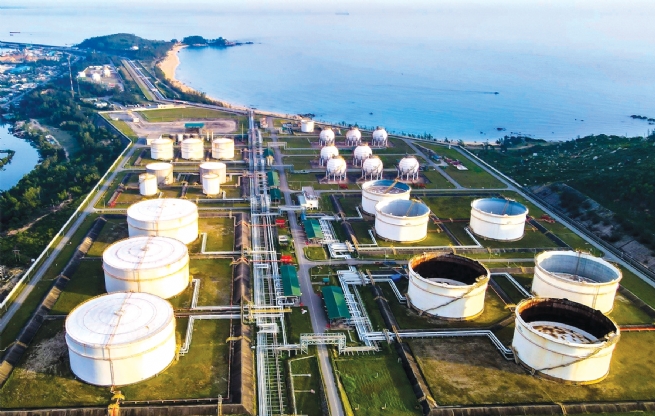
Maintaining refinery operations is a key task to ensure a stable fuel supply for production and daily consumption
Ensuring energy security
Energy security has become a pressing issue, drawing strong attention from the public and policymakers. In response to developments in the Middle East and challenges in the global oil market, the Government has recently held several meetings and issued directives calling for timely, flexible, and effective solutions to ensure domestic energy security. Vietnam’s leadership has also conducted phone discussions and sent official letters to leaders of several countries, while working with ambassadors in Vietnam to seek support in securing energy supplies.
Following the Government’s direction, relevant agencies have used the Petroleum Price Stabilization Fund and adjusted taxes on petroleum products to help stabilize prices. Enterprises have increased the production and supply of petroleum, coal, electricity, and gas for the economy; implemented energy transition measures with new products gradually replacing fossil fuels; promoted efficient and economical energy use; and strengthened inspections and enforcement against smuggling, hoarding, speculation, and profiteering in the petroleum business.
As a result, crude oil supply for domestic refineries has been maintained, and petroleum supply for the current period and the coming months remains stable. Fuel prices are being managed in line with global trends, ensuring that petroleum in particular and energy in general meet production and consumption needs, while minimizing negative impacts on people, businesses, and the economy.
In the coming time, the Middle East conflict is forecast to continue affecting global energy supply chains, particularly petroleum. Rising global oil prices may affect domestic supply and pricing. Therefore, alongside current measures, longer-term solutions are needed to ensure stable fuel supply for production, consumption, and socio-economic development, as well as flexible price management in line with market conditions. Specific tasks and solutions have been assigned to ministries, sectors, localities, and enterprises to achieve the goal of ensuring energy security.
These include maintaining energy security for socio-economic development, avoiding fuel shortages under any circumstances; ensuring crude oil imports; maintaining safe and stable operations at refineries, optimizing processing capacity, and securing supply for the domestic market; and accelerating the production and use of E10 gasoline in line with Government Resolution 36. Petroleum price management will follow global price movements, with the Petroleum Price Stabilization Fund used flexibly and effectively in line with regulations. Efforts to combat smuggling will continue, along with the development of appropriate tax and fee policies for petroleum and input fuels. Vietnam Electricity (EVN) and Vietnam National Coal and Mineral Industries Holding Corporation (Vinacomin) are tasked with reviewing and balancing coal, gas, and fuel supplies for power generation in the coming months, while preparing contingency plans in case imported fuel supplies are disrupted. Engagement with partner countries will also continue to secure fuel supplies for Vietnam, including coal, gas, crude oil, refined petroleum, and aviation fuel.
Continuing to promote exports
The current fuel crisis is driving up transportation and logistics costs, raising export prices and weakening the competitiveness of businesses in international markets. An unstable energy supply is also disrupting production, directly affecting delivery schedules and the reputation of exporting enterprises.
In the first two months of 2026, total trade turnover reached US$155.7 billion, up 22.3% year-on-year; exports totaled US$76.4 billion, up 18.3%, while imports reached US$79.3 billion, up 26.3%. However, since early March 2026, the increasingly complex and unpredictable global environment, with rising risks and challenges, has created difficulties for trade activities.
To respond proactively, flexibly, and effectively to global and regional developments, and to further promote exports in support of the 2026 economic growth target of over 10%, under Official Dispatch 23/CD-TTg dated March 16, 2026 on tasks and solutions to promote exports, ministries, sectors, and localities have been directed to focus on timely measures to address difficulties faced by enterprises in import and export activities. This includes maintaining macroeconomic stability, controlling inflation, promoting growth, and ensuring major economic balances; promptly resolving obstacles for enterprises; and diversifying markets, products, and supply chains. Efforts are also underway to attract investment, boost production and business activities, facilitate the circulation of goods, and accelerate key production and export projects.
In particular, measures are being implemented to ensure sufficient petroleum supply for production and consumption, avoiding any disruption or shortage, and securing adequate fuel for businesses and the public. Support is being directed to localities, industry associations, and enterprises to make effective use of the free trade agreements (FTAs) to which Vietnam is a member, especially those with the European Union, the United Kingdom of Great Britain and Northern Ireland, the Eurasian Economic Union, and the Comprehensive and Progressive Agreement for Trans-Pacific Partnership (CPTPP). Efforts are also being accelerated to negotiate and sign new FTAs, particularly with Latin America, the Middle East, and Pakistan; to expand and effectively tap new markets, especially Halal markets, the Middle East, Latin America, and Africa; and to prepare for discussions with the United States on a reciprocal, balanced, and fair tariff agreement.
At the same time, activities to connect domestic enterprises with foreign-invested enterprises are being strengthened, encouraging domestic firms to participate more deeply in foreign-invested supply chains. Negotiations to open markets and achieve mutual recognition in food safety are also continuing, helping expand market access for Vietnam’s key fruits and vegetables.
Amid many unpredictable developments, proactively ensuring energy security alongside the coordinated implementation of export promotion measures will be key to maintaining economic stability, strengthening resilience, and sustaining growth in Vietnam.
By Anh Mai, Vietnam Business Forum


 Vietnamese





