

10:05:05 AM | 5/6/2026

The decision to move Vietnam into the emerging market category places its stock market at the threshold of a new phase, accompanied by rigorous tests. As old barriers give way to global standards, a promising “billion-dollar” arena has officially begun, reserved for investors capable of adapting to stricter requirements.
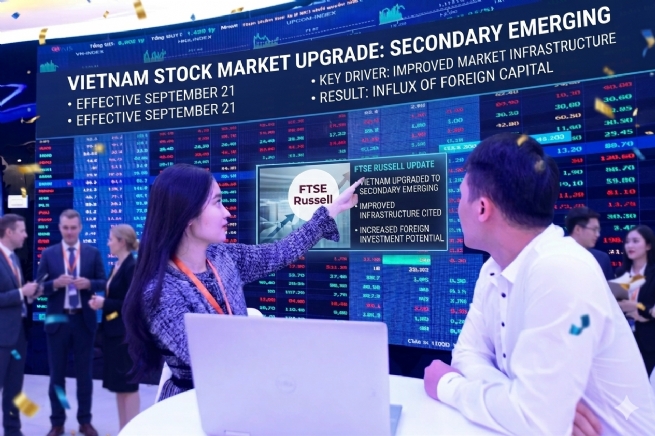
Upgrading Vietnam’s stock market to secondary emerging status is expected to open a new phase of development
Clearing policy bottlenecks
On April 8, FTSE Russell officially confirmed the upgrade of Vietnam’s stock market from frontier to secondary emerging status, effective September 21. The key factor behind this shift is the improvement in market infrastructure. The FTSE Russell Index Governance Board (IGB) stated it is “satisfied with the progress in implementing the foreign securities ownership model, an essential factor supporting index replication.”
FTSE Russell’s confirmation of the upgrade roadmap reinforces the Government’s efforts to remove legal bottlenecks. In this context, Circular 08/2026 issued by the Ministry of Finance serves as a “passport” for Vietnam’s stock market to enter global capital markets. By introducing a non-prefunding mechanism, Vietnam has removed one of the biggest technical barriers for international institutional investors, allowing global securities firms and custodian banks to operate in line with international standards.
According to experts, Circular 08/2026 provides a solid legal framework that ensures fair access for foreign investors, helping improve liquidity and strengthen Vietnam’s position within the global financial system. Consistent implementation across regulators and financial institutions has created a safer and more transparent ecosystem. This is especially significant as the market capitalization of the FTSE Frontier Vietnam Index has increased fivefold, from US$11 billion in 2015 to US$59 billion in 2025, surpassing regional peers such as the Philippines in scale.
Foreign capital flow path
With legal barriers easing, attention has shifted to the path of foreign capital flows. The upgrade will not happen all at once but will be phased to maintain stability. Starting in September, the weighting of Vietnamese equities in global indices will gradually increase according to the schedule: 10% -> 20% -> 35% -> 35%. FTSE Russell indicates that this approach is designed to ensure the transition matches the market’s capacity.
Notably, active funds tend to deploy capital early in anticipation of the official inclusion date.
According to the Research Center of SSI Securities Corporation (SSI Research), about US$1.7 billion from passive funds (ETFs) is expected to flow into the market. Phased capital allocation, based on lessons from Saudi Arabia in 2019, is seen as a practical strategy to help the market absorb inflows steadily and avoid overheating. Vietcap Securities JSC (Vietcap) shares this view, suggesting that capital will come in gradually rather than in a sudden surge, giving domestic investors time to adjust.
Vietcap also assesses that joining larger markets such as China, India, and Brazil will reshape Vietnam’s position in global indices, supporting steady growth in market capitalization and the development of the domestic investor base.
Stocks aligned with foreign investor demand
A closer look at the list of 32 potential stocks under FTSE Russell’s review shows a clear preference for leading companies. Names such as HPG (Hoa Phat Group), VCB (Joint Stock Commercial Bank for Foreign Trade of Vietnam), VIC (Vingroup), VHM (Vinhomes), and FPT (FPT Corporation) represent not only large market capitalization but also strong compliance with liquidity and free-float requirements. Foreign capital is, in effect, focusing on the core strength of Vietnam’s economy through two main sectors: real estate (accounting for 39.9% of weighting) and financials (25.3%).
In the short term, however, SSI Securities Corporation points to challenges such as temporary pressure on liquidity and a narrowing gap between stock returns and bank deposit interest rates. This calls for more selective investment strategies. Sectors such as banking, including CTG (Vietnam Joint Stock Commercial Bank for Industry and Trade) and MBB (Military Commercial Joint Stock Bank), consumer goods, construction materials such as HPG (Hoa Phat Group), and technology led by FPT (FPT Corporation) are expected to act as relatively safe and promising options during periods of interest rate fluctuation.
Experts from SSI also caution that capital inflows will not be deployed in a single wave. Investment strategies should therefore focus on selectivity, targeting companies with positive earnings prospects in the first quarter and stocks with clear reclassification stories to capture institutional inflows more effectively.
The stock market upgrade creates an opportunity to attract strong capital flows that could open a new chapter for the financial market. As foreign funds begin to view Vietnam as an integral part of their emerging market portfolios, domestic companies face pressure to raise their standards to match the scale of incoming billion-dollar capital flows.
By Huong Ly, Vietnam Business Forum




 Vietnamese





