2:07:04 PM | 5/11/2026

In a new phase of development, the Gia Lai Department of Agriculture and Environment is carrying out a comprehensive restructuring toward a green, modern, and sustainable model. Guided by added value, technology, and environmental stewardship, the sector serves not only as a backbone of the economy but also as a key driver of investment attraction and stronger competitiveness.
Developing an ecological, modern agriculture
For the 2025 to 2030 period, the agriculture and environment sector of Gia Lai province has set a goal of developing ecological, modern, high-value agriculture with sustainable growth. This direction is being implemented in a coordinated way, based on a clear shift from quantity-driven development to improving quality, efficiency, and product value, while ensuring efficient resource use and flexible adaptation to climate change.
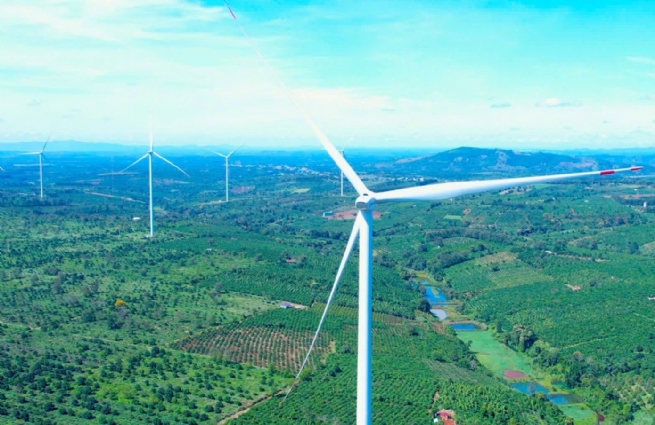
Renewable energy development is one of Gia Lai’s five economic pillars. In the photo: Tay Nguyen Processing Wind Power Plant in Bau Can commune, Gia Lai province
The province’s central priority is to reorganize agricultural production toward large-scale commodity output linked across value chains from production to processing and distribution. Specialized farming areas and concentrated raw material zones are being developed to support deep processing industries and exports, focusing on key products such as coffee, pepper, rubber, cashew, durian, bananas, and passion fruit. At the same time, the province continues to maintain stable production of staple crops and vegetables, ensuring food security and meeting essential needs.
A key direction for the province is to improve production quality through the adoption of safety and organic standards, traceability systems, and planting area codes. This is seen as a decisive factor in strengthening competitiveness, meeting increasingly strict international market requirements, and expanding export opportunities for Gia Lai’s agricultural products.
In livestock, the province is promoting industrial-scale development with high-technology applications and disease control, while gradually reducing small-scale household farming.
For fisheries, the sector is pursuing sustainable development by gradually reducing near-shore fishing and improving the efficiency of offshore operations in line with international regulations on illegal fishing. At the same time, aquaculture is being promoted with high-technology applications, particularly in marine shrimp farming and cage fish farming in hydropower reservoirs.
Forestry continues to be identified as a key pillar of sustainable development. The province is promoting large timber plantations, developing non-timber forest products and forest environmental services, while leveraging eco-tourism potential. Gradual participation in the carbon market helps enhance the economic value of forests and opens new paths for green economic development. By 2030, forest coverage is targeted to reach approximately 46.5%.
Alongside production development, the new rural development program is being carried out with a focus on improving quality, linked to rural economic growth, OCOP products, and agricultural tourism. Policies supporting livelihoods, vocational training, and job creation continue to be prioritized, particularly in ethnic minority and mountainous areas.
Through coordinated implementation of these key tasks, Gia Lai’s agriculture and environment sector aims to achieve an average GRDP growth rate of about 3.8 to 4% per year by 2030, contributing nearly 20% to the economic structure and reinforcing its role as a strong pillar of the local economy.
Improving the Provincial Green Index
Alongside production restructuring, the sector has identified green development, the circular economy, and improving the Provincial Green Index (PGI) as central tasks. This is both a necessary requirement in the new development context and a key factor in enhancing competitiveness and shaping Gia Lai’s image as an environmentally friendly investment destination.
Accordingly, the sector has proactively contributed to major directions in the Provincial Party Congress Resolution as well as in action programs and socio-economic development plans. Priorities include restructuring the economy in line with digital and green development, promoting science, technology, and innovation, and prioritizing investment attraction in renewable energy, eco-industrial development, high-technology agriculture, and large-scale projects using advanced technologies. Notably, a plan to improve and enhance the Provincial Green Index has been issued with a set of specific objectives and solutions, along with clearly assigned responsibilities for each department, sector, and locality.
Business support efforts have been strengthened with a practical approach. The sector has expanded training and advisory activities on environmental protection, helping enterprises understand legal requirements and access technical solutions for waste treatment and environmental management. At the same time, inspection and supervision are carried out in a transparent and fair manner, ensuring effective pollution control while maintaining a healthy business environment without placing unnecessary pressure on enterprises. A key initiative is connecting enterprises with advisory organizations on green transition and ESG, enabling the development of suitable transition roadmaps that strengthen governance capacity, expand access to international markets, and unlock green financing.
Alongside business support, the sector is also advancing administrative reform and improving service quality, with citizen and enterprise satisfaction as the benchmark. In 2025, it achieved a score of 94.5, ranking second province-wide in the index measuring service to citizens and businesses, providing clear evidence of these efforts.
To sustain and build on these results, the sector continues to implement coordinated solutions, including strengthening administrative discipline and order, and accelerating the use of information technology and digital transformation in management and operations.
In the coming period, the sector will continue to refine mechanisms and policies to support enterprises in green transition in a more coordinated and effective way. Priorities include strengthening communication and training to raise awareness, improving the capacity of officials to guide enterprises on environmental and ESG standards, developing advisory and training services for green investment, and reviewing, refining, and effectively implementing the province’s green growth plan.
With comprehensive solutions and close coordination with the business community, Gia Lai’s agriculture and environment sector is steadily reinforcing its role as a foundation for green economic development, contributing to a sustainable investment environment.
Thien Thanh (Vietnam Business Forum)






 Vietnamese