Science and technology now contributes only roughly 30 percent of the value increase for agriculture overall, but two or three times the value increase for the dairy industry, making a decisive contribution to the success of this industry, helping improve milk quality, lowering costs, enhancing competitiveness in the international economic integration, said former Deputy Prime Minister Nguyen Cong Tan at the international conference on Hi-tech Application and Sustainable Development of Fresh Milk Production in Vietnam.
The event was organised by the Institute of Policy and Strategy for Agriculture and Rural Development (Ministry of Agriculture and Rural Development of Vietnam – MARD), Association of Advanced Technology Enterprise in Agriculture (ATE) and the Embassy of Israel in Vietnam.

Situation
According to statistics of Vietnamese Ministry of Agriculture and Rural Development by the end of 2012, Vietnam's total dairy cow herd reached nearly 170 thousands, of which 120 thousands or so are being raised in separate small farms (5-7 cows per each). As a result of lacking hi-tech application, the productivity of milk produced is low and the quality of raw milk is not guaranteed. To many enterprises purchasing milk from different households, though the pre-set quality standards are not harsh, up to 20-50 percent of total milk volume still did not meet requirements.
Since the material supply is inadequate, most of materials to produce milk in Vietnam are imported from foreign countries. Dairy industry always suffers the trade deficit in both volume and value. Vietnam is in top 20 countries importing highest amount of milk material in the world, each year Vietnam imports approximately 1.2 million tonnes of different milk types, mainly condensed and recombined milk (HS Code 0402). About liquid milk, more than 70 percent of material is recombined milk which originated from imported milk powder. Obviously, the quality of such product cannot compare with pure fresh milk. Paradoxically, recombined milk is sometimes even more expensive than fresh milk. The current situation of Vietnam dairy industry, develops the product before the material, is opposite to the world trend.
Another issue of Vietnam's dairy industry is unclear legal framework as well as problematic classification standards of fresh milk.
Information on dairy products seems to be vague, making consumers fall into the information matrix of the dairy industry. Information about dairy products is limited and without transparency. Uninsured milk quality also results in loss of consumer confidence in domestic dairy products. Thus, consumers switch to imported milk which causes losses to the dairy industry in Vietnam.
In addition, there hasn’t been any consistent planning and standards for dairy industry, which is to clarify standards of dairy farming on high technology chain. There is also a big gap in technology ability. The question is how to recognise the best raw milk or fresh milk. And once clear rules about fresh milk regulations are created, the issue of sustainable development is raised. Foreign experts as well as local policy makers assess that the short way to foster the sustainable development of dairy industry and dairy farming in Vietnam is to apply high technology in farming and high quality milk production.
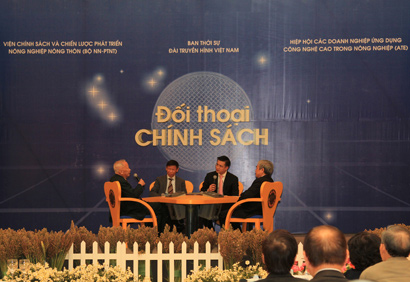
Policy dialogue on the application of high technology in agriculture
Hi-tech application in milk production
TH True Milk is the first and typical success story of the model of hi-tech applications in fresh milk production in Vietnam. On the basis of studying the modern technology of the world, especially that of Israel, a country with geographical conditions semi-desert, with no more blessed condition but has moved to the forefront of world power milk yield and quality, TH Group has applied Israel’s high technology to large -scale industrial dairy Project in Nghe An. Thus, after 14 months, thanks to TH’s model of technology application in dairy farming and milk production, the company has successfully launched clean pure fresh milk products (TH true MILK) with high quality international standards and high trust customer confidence.
With the total investment of US$1.2 billion, the project has a large scale, closed process and is well-equipped with the most modern machines and technologies in Asia. The operation of TH true Milk project has made contribution to change the Vietnamese liquid milk industry’s situation, decreasing the amount of reconstitute milk from 92 percent to 70 percent. With internationally standardized clean fresh milk quality certified by closed process “from grassland to dining-table”, TH Corporate fresh milk project has placed the first bricks to lay the foundation for clean fresh milk industry in Vietnam, creating new standard level for the whole industry.
Prof. Dang Kim Son, President of Institute of Policy and Strategy for Agriculture and Rural Development said that TH true Milk’s model in Vietnam – large-scale dairy cow breeding with internationally leading quality outputs produced in not favorable natural conditions of Western Nghe An, so far, has been demonstrating the successful case of high technology application.
Ms Thai Huong, President of TH Group said that with the closed model and application of the world high technology to agricultural, TH Group has produced fresh and clean dairy products, with desire to bring valuable source of nutrition to Vietnamese people. Besides, with a total of up to 35,000 cows (as of May 10, 2013) accounting for 20 percent of the country's, TH contributes to the implementation of key objectives of the Vietnam’s dairy cows development strategy untill 2020 launched by Ministry of Agriculture and Rural Development, to increase the number of cows by 500 thousand. Dairy cows development under the standards means to supply clean and fresh raw milk to produce clean and fresh milk products with international quality.
From TH’s accumulated practical experience, Ms Thai Huong also suggests the help from functional administrative units to sustainably develop Vietnam’s agriculture in general as well as clean and fresh dairy sector in particular. Specifically, it needs preferential interest rate, credit, land, industry’s training support, and information support for enterprises to bring high technology applications in Vietnam, as it is the most proper way and the inevitable direction for clean and fresh milk sector in the future. Furthermore, to bring the best benefit to consumers needs specific regulations on milk quality standards, and clear product information to avoid misleading consumers.
Mr Yuval Rachmilevitz, Afimilk CEO (Israel)
Farms that produced 6-7 tonnes of milk per cow a year in the 80’s in Israel, produce 12-13 tonnes in 2013. It took us 20 years of well-maintained and managed farms to reach this goal.
10 years penetrating the international markets, we now have big commercial dairy farms that produce 9-10 tonnes a year.
If in Israel 120,000 cows produce enough milk to meet the demand of a population of 7 million. If we assume that milk consumption in Vietnam will reach half the average of consumption in Israel, there will be 500,000-600,000 highly producing cows in Vietnam by 2020, six times more than today.
When we came to Vietnam in 2008, average production of cows was less than 4 tonnes a year, it is now more than twice as much and it will continue improving in years to come.
Huyen Nhi


 April 24–25, 2026
 Kinh Bac Cultural Center, Bac Ninh Province


 Vietnamese





