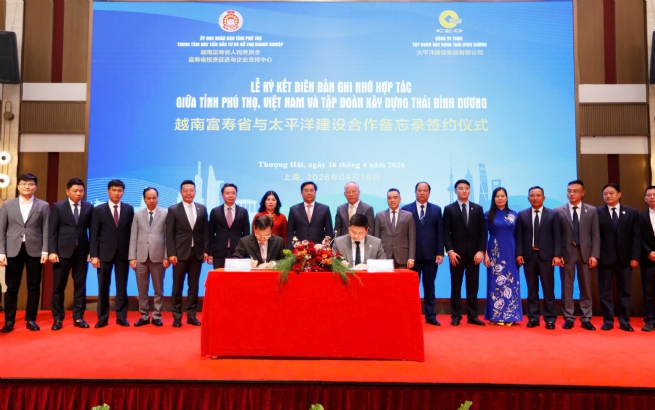
On November 21, 2005 in Texas, the US, Vietnam Airlines (VNA) and American Airlines (AA) signed an agreement on joint operation of routes from the US to Vietnam, Japan and Europe, and vice versa.
Under the agreement, in the first phase, which begins in 2006, VNA’s designator code will be placed on flights of American Airlines from the US to Tokyo, Osaka, Paris and Frankfurt and from the US, which connect to VNA’s flights to Hanoi and Ho Chi Minh City. In the following phase, AA’s designator code will be placed on VNA’s flights from Hanoi and Ho Chi Minh City to Tokyo, Osaka, Paris and Frankfurt.
Taking part in the joint operation, VNA is allowed to exploit flight routes from 25 destinations in the US market and many major international flight routes. VNA is expected to serve around 40,000 American passengers in 2006 compared to 30,000 in 2005. This is an important landmark for VNA to accelerate its plans on open direct flight routes between Vietnam and the US.
In late 2004, another US carrier, United Airlines opened a direct flight route between San Francisco and Ho Chi Minh City, putting Vietnam into a list of potential markets for American carriers.
These are important results achieved within the Vietnam-US co-operation in aviation. Earlier, in late 2003, the two countries signed the aviation agreement after five years’ negotiation.
Under the agreement, Vietnam has negotiated on the amendment and supplement to its bilateral aviation agreements with ASEAN and Northeast Asian countries, Australia and New Zealand, Canada and Germany, bringing the total number of bilateral aviation agreements between Vietnam and foreign countries to 57. The agreements have modern regulations, suitable with the development and liberalisation of world aviation transportation, as well as the liberalisation of flight route opening and code-sharing.
Apart from signing bilateral co-operation agreements, so far the Vietnamese aviation has joined most multilateral economic co-operation and professional forums, such as ASEAN, the Asia-Pacific Economic Co-operation Forum (APEC) and the International Civil Aviation Organisation (CIAO).
One of the major achievements of the Vietnamese aviation in regional multilateral co-operation, which acts as a launch pad for co-operation at a larger level, was the building and signing of the Agreement of Heads of the Civil Aviation Administrations of Cambodia, Laos, Myanmar and Vietnam on Sub region Aviation Transportation in Hanoi in 1998. Vietnam Airlines has implemented effectively the agreements on exploiting the markets within the Cambodia, Lao, Myanmar and Vietnam subregion, in particular exploiting flights linking Vietnam and Cambodia.
Within ASEAN co-operation, Vietnam has become active in negotiating on the building of policies on the liberalisation and co-operation in ASEAN aviation transportation. For the negotiations on opening the aviation transportation market under the ASEAN Frame Agreement on Aviation Services, Vietnam has offered the highest priorities to ASEAN service suppliers. For the negotiations on the building of policies on the building of ASEAN aviation transportation policies, as chairman of the ASEAN aviation transportation working group in the 2004-2005, Vietnam made an important contribution to the building and approval of the Programme of Action on Integration and Liberalisation of Aviation Transportation for the 2005-2015 period.
ASEAN’s target in which Vietnam is an active member is to completely liberalise cargo transportation in 2008 and passenger transportation in 2010. This is to gradually build a unique ASEAN aviation transportation market in 2015 with an ASEAN multilateral agreement on aviation transportation, which will replace bilateral co-operation agreements among the block’s member countries.
For APEC co-operation, based on its experience of the integration into ASEAN, the Vietnam Civil Aviation Administration has made good preparations for co-operation on a larger scale. Accordingly, the administration has announced the National Plan of Action on Aviation Transportation, identifying a roadmap for the liberalisation of aviation transportation service liberation throughout 2020.
The sector has contributed significantly to Vietnam’s negotiations on its accession to the World Trade Organisation (WTO) by generalising documents and developing suitable negotiation plans, as well as getting ready for concrete commitments on the opening of the aviation transportation market under the General Agreement on Trade in Services (GATS).
Having implemented its international commitments, Vietnam completed its roadmap for harmonisation of fares for Vietnamese and foreign passengers on its local flight routes on January 1, 2004. This has helped the Vietnamese aviation transportation market increase its competitiveness and the Vietnamese aviation industry raise its prestige. The recent agreement between VNA and AA is one good example of this.
Tung Son






 Vietnamese