

10:54:31 AM | 4/29/2026

With total assets exceeding VND1.1 quadrillion (about US$45.8 billion), profit nearing VND29 trillion (about US$1.2 billion), more than 30 million customers, and 6.2 billion digital transactions each year, Military Commercial Joint Stock Bank (MB) is building a new growth model based on technology platforms, strong risk governance, and a multi-layered financial ecosystem, instead of relying on traditional credit.

MB is shifting from a traditional banking model to a platform-based financial group
Platform strategy: Evolving into a digital enterprise
The 2025 annual report shows a consistent direction in MB’s development: a shift from a traditional banking model to a platform-based financial group. This is not just about digitizing services, but a broader restructuring of how the bank creates value.
From a financial perspective, MB continues to rank among the leaders, with pre-tax profit of approximately VND28.8 to VND29 trillion, while maintaining solid safety indicators. The more notable point is the quality of growth. The current account savings account (CASA) ratio remains around 39 to 40%, among the highest in the market, allowing the bank to keep funding costs low, optimize net interest margins, and strengthen competitiveness.
At the same time, the customer base has surpassed 30 million, the largest in the system, creating a clear advantage in data and service scalability. Combined with its technology platform, this large customer base becomes a “strategic asset,” enabling MB to develop personalized financial products at significantly lower cost than traditional models.
Notably, MB’s digital operations have reached the scale of a major technology platform, with more than 6.2 billion transactions annually and an almost perfect success rate. This reflects a shift from a “service-providing bank” to a “digital financial infrastructure,” where the bank operates behind customers’ everyday financial activities.
From a strategic standpoint, this model allows MB to gradually reduce dependence on pure credit growth, which carries cyclical risks, and instead capture value from its ecosystem, data, and user experience. This direction aligns with an industry under pressure from fintech and new financial models.
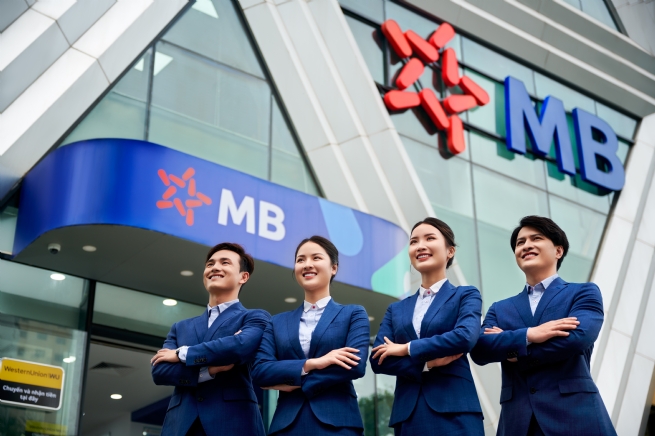
MB Bank focuses on building a positive working environment and fostering a sustainable corporate culture in the digital era
Risk governance and ecosystem - foundations for sustainable growth
If the platform strategy is the “growth engine,” then risk governance and the ecosystem form the “chassis” that allows MB to operate steadily over the long term.
In terms of risk governance, MB maintains its non-performing loan ratio at around 1.3 to 1.6%, below the system average. The key lies not only in the figure, but in the bank’s proactive and integrated approach to risk.
MB has implemented governance standards under Basel II, moving toward Basel III, while applying big data and artificial intelligence (AI) widely in credit appraisal and portfolio monitoring. With a customer base in the tens of millions, data use improves the bank’s ability to forecast and control risk from the outset, rather than reacting after issues arise.
In addition, the high CASA ratio not only provides a cost-of-funds advantage but also serves as an important liquidity buffer. Amid financial market volatility, maintaining stable, low-cost funding is a key factor in protecting profit margins. Alongside risk governance is a strategy to build a multi-layered financial ecosystem. MB does not operate as a standalone bank, but develops a network of subsidiaries across sectors such as securities, insurance, and asset management, forming an integrated value chain.
This model allows the bank to deliver comprehensive financial solutions, from credit and investment to insurance, rather than offering standalone products. With a base of more than 30 million customers, each new service can quickly reach the market without requiring high distribution costs.
More importantly, the ecosystem diversifies revenue streams, reducing reliance on credit, an area sensitive to economic cycles. At the same time, data sharing among ecosystem entities creates synergies that improve how customer value is captured.
From a long-term perspective, the combination of disciplined risk governance and an expanding ecosystem allows MB to build a “controlled” growth model, in which profit is not traded off against risk, and scale does not reduce quality.
ESG and long-term vision
A notable aspect of MB’s development direction is the integration of ESG (Environmental, Social, and Governance) factors into its business strategy.
On the environmental front, the bank is gradually applying green credit criteria, prioritizing environmentally friendly projects and managing risks related to climate change. This is not only a compliance requirement, but also a condition for accessing international capital in the future.
On the social dimension, the expansion of digital banking improves access to financial services for a wider range of customers, particularly in underserved areas. This contributes to financial inclusion while opening new avenues for growth.
In terms of governance, MB maintains transparency standards, internal controls, and corporate governance practices in line with international norms. This provides a strong foundation for strengthening investor and market confidence, particularly as transparency requirements continue to rise.
ESG at MB is not separate from business operations, but integrated into strategic decisions. This allows the bank not only to meet international standards, but also to use ESG as a long-term competitive advantage.
From financial indicators to strategic direction, MB is entering an important phase of transformation. Rather than relying on traditional credit growth, the bank is building a new growth foundation based on technology, data, risk governance, and its ecosystem. As the banking sector faces rising competitive pressure and restructuring demands, MB’s model offers a clear path: growth anchored in digital platforms and modern governance, aimed at sustainability rather than expansion at any cost.
By Hien Le, Vietnam Business Forum


 Vietnamese





