

10:53:13 AM | 1/19/2026

Japan has one of the world’s most advanced innovation ecosystems, with around 3.7 million active enterprises that continue to seek advanced technology solutions and cross-border cooperation opportunities. Meanwhile, Vietnam’s startup landscape has continued to grow strongly, with nearly 178,000 newly established enterprises in the first 11 months of 2025, reflecting a broad digital transformation trend and the rise of deep-tech and AI models. Promoting technology cooperation and co-creation models driven by market demand has therefore become a direction of shared interest for both countries.
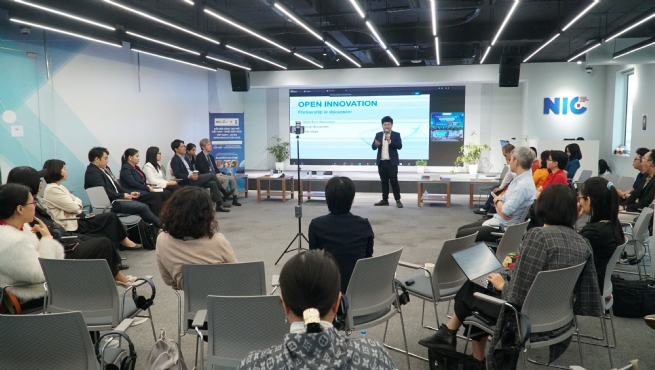
Delegates engage in discussions at the Vietnam-Japan Open Innovation program
Open startup development potential
The year 2025 marked two years since Vietnam and Japan upgraded their relationship to a Comprehensive Strategic Partnership, with cooperation centered on innovation, green transformation, and high-quality human resource development. In this setting, open innovation has become an effective way to link business needs with flexible and scalable technology solutions from startups, speeding up commercialization and creating new opportunities for bilateral cooperation.
At the same time, startups still face obstacles in early market access and in forming partnerships with large enterprises, while many companies lack suitable channels to test and deploy new technologies at home. Open innovation helps close this gap by directly matching real business challenges with practical solutions from the startup ecosystem.
At the recent “Vietnam-Japan Open Innovation” event organized by the National Innovation Center (NIC), the Embassy of Japan in Vietnam, and the United Nations Development Program (UNDP) in Vietnam, Do Tien Thinh, Deputy Director of NIC, said Vietnam’s innovative startup ecosystem currently includes around 4,000 startups, more than 1,400 startup support organizations, 280 investment funds, 79 incubators, about 170 universities and colleges engaged in startup and innovation activities, and more than 20 local and national innovation centers.
According to assessments by the World Intellectual Property Organization (WIPO), Vietnam ranks 44th out of 139 economies in the Global Innovation Index (GII). This position stands out, as economies with similar per capita income levels typically rank between 70th and 80th. In particular, Vietnam’s innovation output indicators are within the top 40 globally. For input indicators, forecasts suggest notable increases in the coming years, supported by rapid policy changes and the introduction of multiple laws, resolutions, and supporting strategies.
According to Thinh, open innovation, as part of broader innovation activities, is increasingly adopted by enterprises, with many using collective knowledge and external partner resources to support and develop their business areas. This approach allows large enterprises to access solutions that are faster, more cost-effective, and more novel, while startups gain opportunities to reach the markets and customers of major corporations.
Many programs supporting innovative startups
According to Do Tien Thinh, NIC is working with Japan’s Ministry of Economy, Trade and Industry (METI), the Executive Office of Japan (EOJ), and the Japan External Trade Organization (JETRO) to organize the “Inno Vietnam - Japan Fast Track Pitch 2025.” The program aims to support enterprises from both countries in developing practical solutions to real business challenges. Companies with suitable solutions can co-develop products, strengthen their brands, expand business networks, and participate in innovation ecosystems in Vietnam, Japan, and the wider region. Selected startups may sign cooperation agreements with major Vietnamese and Japanese corporations and receive investment and technical support from NIC and JETRO.
Enterprises presenting challenges in this round include MUFG (seeking strategic partners in agri-tech, fintech, and supply chain solutions), Petrovietnam (developing sustainable and globally scalable AI solutions to improve operational efficiency), Thang Long Industrial Park (seeking innovative solutions to achieve carbon neutrality and improve quality of life for 90,000 employees), NTT West (seeking partners to build platforms for a global IP voice economy), Rikkei (applying generative AI to optimize system development processes, increase enterprise value, and advance digital transformation), and Viettel Software (co-creating the next generation of work and digital intelligence).
Recently, 22 high-potential technology startups have been supported under two key initiatives implemented by NIC in cooperation with Japanese partners. These include the project “Enhancing the Innovation Support Capacity of the National Innovation Center,” funded by the Government of Japan and jointly implemented by UNDP and NIC, and the VietLeap AI Accelerator Program, a strategic initiative led by NIC in collaboration with JICA, BCG, and the Embassy of Japan to promote Vietnam’s AI ecosystem. More than 50 in-depth business matching sessions between startups and leading corporations from both countries have demonstrated the effectiveness of the “challenge-solution” model in reducing technology adoption risks, accelerating proof-of-concept implementation, and expanding commercialization opportunities.
“Vietnam-Japan Open Innovation is a multi-dimensional cooperation space where Japanese enterprises can openly share specific business challenges and invite Vietnamese startups to propose innovative solutions,” said NIC Director Vu Quoc Huy.
With Vietnam’s entrepreneurial spirit combined with Japan’s technological capabilities and enterprise scale, the Vietnam-Japan Open Innovation platform is positioned as a strong driver of cooperation, aimed at co-creating solutions that can scale across regional and global markets, marking the beginning of a new era of collaboration.
By Quynh Anh, Vietnam Business Forum





 Vietnamese





