

11:02:43 AM | 2/18/2026

The business environment in Vietnam has continued to improve as the Government accelerated administrative reform, strengthened institutions and advanced digital transformation in management. At the same time, the revision of several key laws, particularly the Law on Investment, broadened opportunities for business and established a foundation for sustainable growth in the period ahead.
Drivers of business environment improvement
According to the Department of Private Enterprise and Collective Economy Development under the Ministry of Finance, enterprise development in 2025 recorded many positive results. Among international indicators, Vietnam achieved a strong result in the E-Government Development Index (EGDI), reaching 0.7709 points and placing in the very high group, ranking 71 out of 193 countries. The International Property Rights Index (IPRI) score decreased by 0.1 point to 4.306 points, but Vietnam’s ranking improved by two places to 13 in Asia and the Pacific and by three places to 82 out of 193 worldwide compared with 2024, meeting the target set in Resolution 02/NQ-CP.
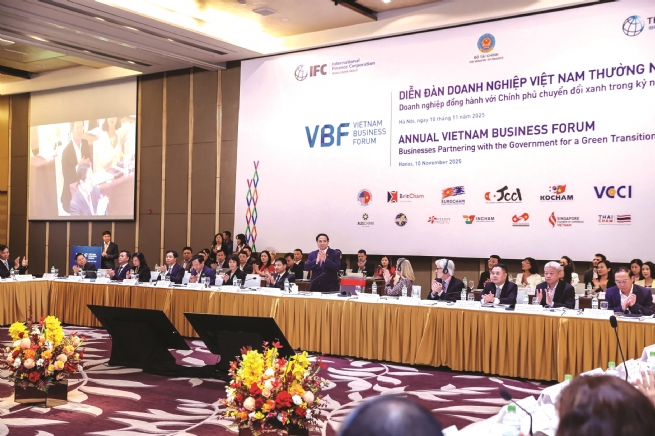
The Vietnam Business Forum 2025 reflects strong alignment between the Government and the business community in advancing green and digital transformation and mobilizing resources for sustainable development
However, Vietnam only ranked the 44th position out of 139 economies in the Global Innovation Index (GII), and the Sustainable Development Goals (SDG) index in 2025 reached 73.4 out of 100 points, standing at 61 out of 167 ranked countries, not reaching the target of entering the Top 50.
According to data from the National Statistics Office under the Ministry of Finance, Vietnam recorded 195,100 newly registered enterprises in 2025 with total registered capital of VND1,919.2 trillion (US$76.77 billion), representing increases of 24.1% in both the number of enterprises and registered capital. Total additional registered capital injected into the economy during 2025 reached nearly VND6,400 trillion (US$256 billion), up 77.8% from 2024. The country also saw 102,300 enterprises resume operations, up 34.3% from 2024, bringing the combined number of newly established and reactivated enterprises to 297,500, up 27.4% year on year. These figures reflected the strong resilience of the enterprise sector amid gradual economic recovery, indicating firmer market confidence and a more attractive business climate, providing a solid base to sustain growth momentum in the years ahead.
In particular, the revised Law on Investment approved by the National Assembly is regarded as an important reform step to simplify procedures, broaden investment opportunities and improve transparency in investment and business activities.
Accordingly, the revised law reviewed and sharply reduced the list of conditional business lines. The Government removed 38 business lines and adjusted the scope of 20 others in line with the spirit of Resolutions 68 and 198 on improving the business environment. It also significantly narrowed the range of projects requiring investment policy approval, limiting this requirement to important and sensitive fields such as seaports, airports, telecommunications, press, publishing, and projects related to national defense and security. This adjustment aimed to reduce procedural layers, shorten processing time and accelerate project implementation.
A major reform of the revised Law on Investment allowed foreign investors to establish economic organizations before applying for investment registration certificates. This was regarded as an important step in improving the investment environment, helping shorten the time required to start a business and increasing the attractiveness of the Vietnam market.
The law also added provisions to clarify principles for determining business investment conditions as a basis for reviewing, screening and classifying industries and trades that genuinely require prior control. Industries and trades with conditions applied to output products and services that can be managed through technical standards issued by competent authorities will shift to a post-control mechanism, moving from licensing to registration or notification. Strong priority was given to high technology, innovation and the green economy, which are the main directions for investment attraction that Vietnam is pursuing.
Together with efforts to revise laws such as the Law on High Technology, the Land Law, the Planning Law, the Investment Law and tax laws including the Law on Personal Income Tax and the Law on Tax Administration, Vietnam’s investment and business environment is expected to continue improving strongly in the coming period.
Even so, the business community still faced many difficulties. The number of enterprises temporarily suspending operations in 2025 reached 114,400, up 14.3% compared with 2024, while 76,900 enterprises ceased operations pending dissolution procedures, up 0.9%, and 35,900 enterprises completed dissolution procedures, up 66.1%.
According to Trinh Thi Huong, Deputy Director of the Department for Private Enterprise and Collective Economic Development, many enterprises had to delay or cancel business plans due to complicated procedures related to land and obstacles in access to finance, although capital demand remained an essential condition for expanding operations.
Institutional reform as the center of development
According to Nguyen Bich Lam, former Director General of the General Statistics Office, the year 2026 requires strategic decisions to create a foundation for sustainable growth for the entire coming period. Given the high openness of the Vietnam economy, the Government and localities need to focus on several specific solution groups, with institutional reform regarded as the center of development. Without strong reform, all targets for high growth would remain only declarations. In particular, maintaining macro stability and credit stability is necessary as a prerequisite to sustain the recovery momentum of production.
In addition, Lam said it was necessary to unlock domestic aggregate demand and strengthen the role of final consumption in the context of slow global demand recovery.
Monetary and credit policy should be managed flexibly to channel capital flows into new growth drivers. Fiscal policy with clear focus should be implemented to support incomes and stimulate sustainable consumption, while domestic market development should be linked with the digital economy, e-commerce and new consumption models, creating a support platform for growth amid ongoing global uncertainties. International trade in goods should be restructured in line with the reshaping of global value chains, and the domestic economic sector should be strengthened to keep pace with the technology shift driven by artificial intelligence (AI).
At the same time, public investment should be accelerated to lead and activate a new investment cycle associated with the energy transition, and new growth drivers based on the green economy, digital economy and knowledge economy should be promoted. Support should be provided for domestic enterprises to access capital, technology and data, and the application of AI, automation and digital technology in production and business should be expanded to build a group of domestic enterprises with sufficient technological capacity to participate deeply in new global value chains.
At the conference reviewing work in 2025 and deploying tasks for 2026 of the Government and local authorities, General Secretary To Lam said that 2026 marks the beginning of a new development period and a year shaping the long-term growth trajectory, with a challenging GDP growth target of 10% or higher. To achieve this target, he said it is necessary to remove institutional bottlenecks and inadequacies to unlock constrained resources, make a decisive shift from administrative management to development facilitation, and fundamentally transform the growth model toward productivity and innovation, with science, technology, and digital transformation as the main driving forces to overcome the middle-income trap. At the same time, it is necessary to build a modern strategic infrastructure system, improve the implementation capacity of the apparatus under strong decentralization and delegation, and develop high-quality human resources while raising the skill level of the whole society. According to General Secretary To Lam, the country has now gathered sufficient position and strength, as well as the will and determination, to enter an era of prosperous national development.
Vietnam is at a turning point, and aligning efforts to promote growth in 2026 will help the country not only recover and maintain its growth momentum but, more importantly, improve the investment and business environment, strengthen its position in the global value chain and build a foundation for sustainable development in the next decade.
Anh Mai (Vietnam Business Forum)


 Vietnamese





