

9:19:32 AM | 2/12/2026

After a strong breakout year in 2025, with total import-export turnover exceeding US$930 billion, up 18.2% year on year, and a trade surplus maintained for the tenth consecutive year, Vietnam entered 2026 with both solid foundations and a range of new challenges.
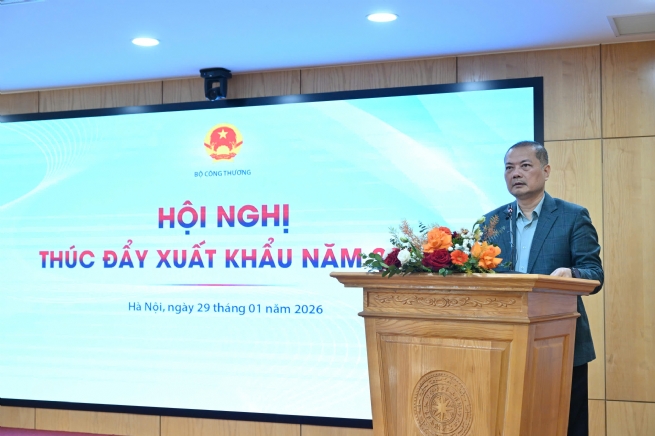
Director General of the Agency of Foreign Trade Nguyen Anh Son addresses the conference on export promotion 2026
As the first year of Vietnam’s 2026-2030 Socio-Economic Development Plan, exports are expected to remain one of the key growth drivers of the economy. However, amid fast-changing and unpredictable global trade conditions, growth opportunities are no longer evenly distributed, requiring Vietnam’s import-export sector to shift toward a more selective development phase that prioritizes quality and sustainability.
Opportunities bring higher risks
Entering 2026, the global economy is expected to continue recovering, but on an unstable footing. Prolonged geopolitical tensions, rising global public debt, and the growing trend toward trade protectionism are making the international trade environment harder to predict than in previous periods.
Major economies are increasingly using tariff tools, technical standards, and trade defense measures with greater flexibility to protect domestic production. At the same time, requirements related to sustainable development, carbon emissions, traceability, and social responsibility are gradually becoming the “new rules of the game” in global trade.
Supply chain restructuring is also advancing more deeply. Global enterprises are no longer focused solely on low-cost destinations, but are prioritizing countries with stable policy environments, the ability to meet green standards, and the capacity to ensure supply chain security. As a result, trade and investment flows have become more selective, while competition among exporting countries has intensified.
In this context, Vietnam, as a highly open economy, is directly affected by external fluctuations, but also has opportunities to participate more deeply in regional and global supply chains if it effectively leverages free trade agreements, geo-economic positioning, and macroeconomic stability.
However, opportunities are no longer available to all. International markets are undergoing stronger screening, and only enterprises that meet standards and demonstrate stable and transparent supply capabilities can maintain market share.
Trade trends in 2026: Growth is more challenging
Based on the positive results of 2025, the Government set a target for export turnover growth of around 15-16% in 2026, equivalent to an estimated export scale of US$546-550 billion. This is an ambitious target amid continued global trade uncertainty, reflecting strong expectations for exports as a driver of economic growth.
A notable trend in 2026 is a clear shift from extensive growth toward more intensive growth. Rather than focusing only on turnover, exports are being oriented more closely toward added value, domestic content, and deeper participation in global value chains.
Processing and manufacturing industries continue to play a core role, but face growing pressure from environmental standards, technical requirements, and sustainable development responsibilities. Many enterprises are required to step up investment in technology, upgrade production processes, and accelerate digital transformation to maintain competitiveness.
At the same time, a structural weakness of Vietnam’s exports remains the heavy reliance on foreign-invested enterprises and imported input materials. In the context of global supply chains that are easily disrupted, this dependence makes production and export activities vulnerable to external shocks.
On the import side, 2026 is expected to see a positive structural shift. Imports of machinery, high-technology equipment, and internationally standardized materials for export production are likely to increase, reflecting a move toward investment in long-term capacity rather than short-term processing.
In parallel, cross-border e-commerce, digital logistics, and the application of technology in supply chain management continue to expand, creating additional market access channels for enterprises, especially small and medium-sized firms. However, these opportunities can only be fully realized when enterprises have sufficient capacity to meet standards and build brands.
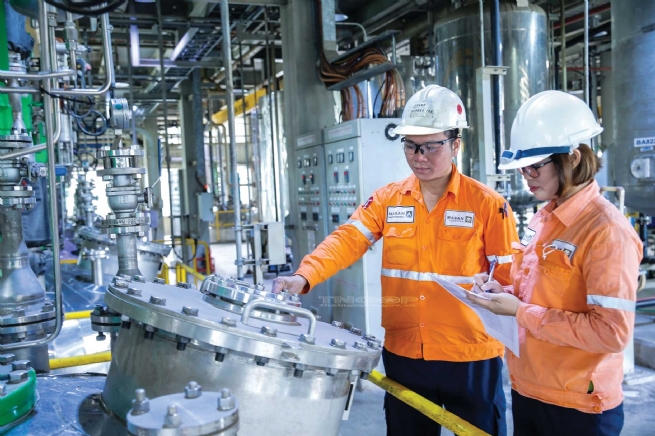
The processing and manufacturing industries are forecast to continue playing a core role in Vietnam’s export sector in 2026
Growth must be based on real capacity
Commenting on the outlook for import-export activity in 2026, Nguyen Anh Son, Director General of the Agency of Foreign Trade under the Ministry of Industry and Trade, said that import-export operations have entered a new phase in which opportunities and challenges are more closely intertwined than in previous years.
According to him, the export growth target of over 15% is demanding, but remains achievable if priorities are set correctly. Those priorities include developing domestic production, increasing added value, and gradually shifting from processing toward substantive production and export activities.
He stressed that building domestic supply chains and strengthening linkages among local enterprises, the foreign-invested sector, and global corporations are key to improving the economy’s resilience to external shocks.
At the same time, new-generation trade barriers - particularly environmental standards, sustainable development requirements, and trade defense measures - are expected to continue rising in 2026. This requires enterprises to be more proactive in accessing market information, complying with standards, and enhancing risk management capacity.
“Vietnam’s exports cannot maintain high growth if they rely only on short-term market recovery. Sustainable growth must be based on the real capacity of enterprises and their ability to adapt flexibly to global trade fluctuations,” Nguyen Anh Son said.
Alongside improving production quality, market diversification continues to be seen as an important direction. Effective use of free trade agreements, combined with expansion into new markets such as the Middle East, Africa, and South Asia, is expected to help reduce risks linked to dependence on a limited number of traditional markets.
The year 2026 is not only a year of ambitious export turnover targets, but also a pivotal year for restructuring import-export activities toward greater sustainability, efficiency, and depth. In a volatile global trade environment, Vietnam’s trade sector can continue to serve as a growth driver only by shifting from “fast growth” to “solid growth,” and from scale expansion to higher value and stronger self-reliance. This is not only a requirement for 2026, but also an important foundation for the economy’s next stage of development.
By Le Hien, Vietnam Business Forum


 Vietnamese





