

3:54:26 PM | 12/19/2025

As safety standards and public expectations keep increasing, the Dien Bien Center for Technical Inspection of Vehicles and Mechanical Equipment (code 27.01S) has reinforced its role as a key technical unit, playing an important part in ensuring transportation safety throughout the province.
Core operations and service quality
The Dien Bien Center for Technical Inspection of Vehicles and Mechanical Equipment is a public service unit under the Dien Bien Department of Construction. It consists of two main divisions: Administration and Inspection, operating efficiently with a team of well-trained, experienced inspectors and technical staff.
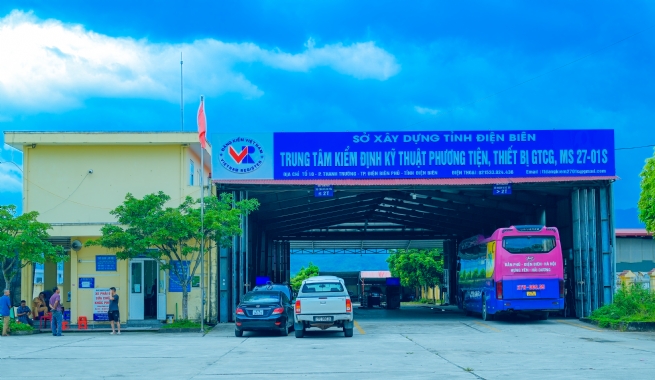
The center plays an important part in ensuring transportation safety throughout the province
The center’s core function is to inspect road motor vehicles and specialized machinery to ensure technical safety and environmental protection, as prescribed by law. It is also responsible for receiving and reviewing technical documents, assessing vehicle conditions, issuing inspection certificates, storing data, and coordinating with competent agencies to handle violations.
Recognizing its role as the “first line of defense” in traffic safety, the center has carried out a series of comprehensive measures to enhance inspection quality. A major initiative is the application of information technology in the inspection process. The center has implemented an integrated data management software system that allows online registration and record tracking, reducing waiting times while improving transparency and accuracy in administrative procedures.
In parallel, the center prioritizes training and professional development for its inspectors and staff. It has standardized inspection procedures to ensure scientific, objective, and rigorous practices while enhancing internal supervision to promptly detect and address operational shortcomings.
Modernization and capacity expansion
The center’s inspection system has been comprehensively upgraded with modern, nationally certified equipment. This includes automated testing lines for brake performance, side-slip, exhaust emissions, and headlight intensity; systems for testing suspension, steering, noise, and emissions; and a camera network that monitors the entire inspection process.
In the coming years, the center plans to further modernize its specialized inspection equipment, particularly systems for diagnosing electronic vehicle components such as the Anti-lock Braking System (ABS) and the Electronic Stability Program (ESP). These upgrades will enable the inspection of electric, hybrid, and other advanced-technology vehicles.
| Since July 1, all fees and charges for technical inspection at the center have been handled exclusively through cashless payment methods, including bank transfers, QR code scanning, and approved e-wallets such as MoMo, ZaloPay, and VNPT Pay. |
Notably, the center intends to apply artificial intelligence and big data analytics to inspection records to identify common faults and issue early warnings to vehicle owners. It also aims to expand its inspection capacity for specialized machinery to meet growing local demand.
Nguyen Dinh Tan, Deputy Director in charge of the center, noted that drawing on its operational experience, the center has proposed several policy recommendations to enhance inspection efficiency. These include updating and refining the legal framework to address emerging vehicle technologies such as electric and autonomous cars; increasing public investment in modern inspection equipment; strengthening coordination with the traffic police and related agencies; introducing incentive policies for inspector training and professional development; accelerating digital transformation and database integration across sectors; and issuing a new inspection fee schedule to replace the outdated 2013 rates, ensuring financial sustainability, fair compensation, and long-term growth of inspection units.
Ngoc Tung (Vietnam Business Forum)


 Vietnamese





