


Craft villages in the capital Hanoi have long contributed to rural economic development, creating jobs and increasing incomes for local workers. More than spaces where handicraft economies, indigenous culture, and folk knowledge converge, they also embody the skillful hands and creative spirit of people, representing a valuable “soft resource” for tourism development.
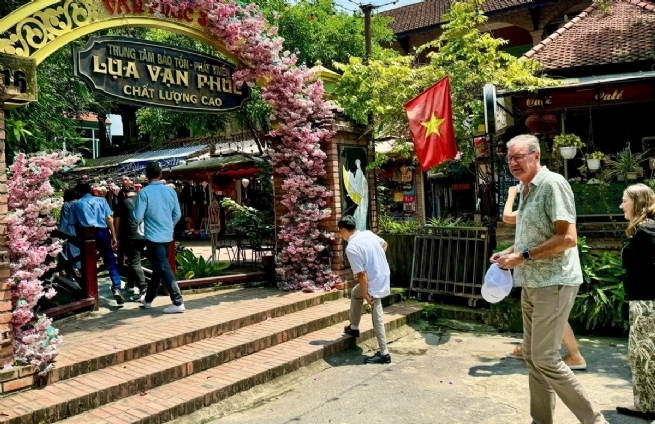
Developing the architectural and landscape space of traditional craft villages to serve tourism is a necessary task
According to experts, orienting the development of architectural and landscape spaces of traditional craft villages for tourism purposes is a necessary task that needs to be clearly addressed in the Capital Planning schemes for the 2021–2030 period, with a vision to 2050, and in the adjustment of the Capital’s Master Plan to 2045, with a vision to 2065, in line with the guidance stated in Conclusion No. 80-KL/TW of the Politburo. This is also intended to develop a focused system of traditional craft villages combined with tourism, ensuring linkage among villages and the effective use of resources.
However, the development of craft village tourism must begin with the preservation and revitalization of crafts themselves, meaning the consolidation of the production foundation, ensuring that “when the craft thrives, tourism can endure.” Despite notable improvements, shortcomings still exist in many craft villages during their construction and development for tourism activities, such as public spaces, residential spaces, and water spaces that have not yet been adequately explored and utilized for tourism.
Visitors to craft villages do not come merely to purchase products, but to experience the creative process—from the selection of raw materials and crafting, to appreciating the historical and humanistic stories behind each product. In this context, handicraft products are not just commodities, but cultural symbols—a form of intangible heritage that can be leveraged for tourism.
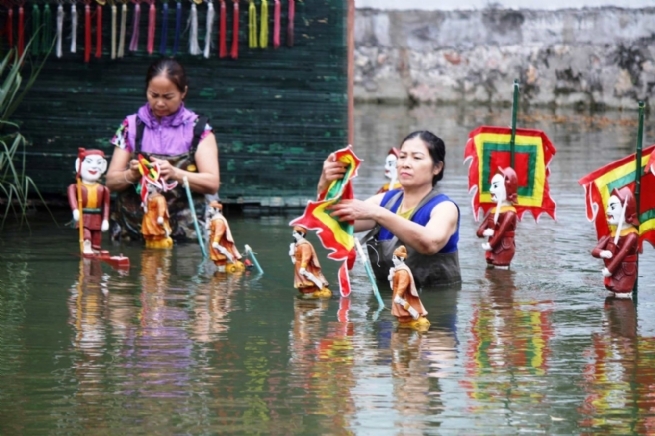
Many Tours of Hanoi City Featuring Bat Trang Pottery Village of Vietnam
In Bat Trang, in recent years, thanks to the attention of leaders and authorities at all levels, activities to protect and promote Bat Trang’s cultural heritage have begun to flourish. In 2019, Bat Trang was recognized as a Tourist Destination of Hanoi City. In 2022, the traditional pottery craft of Bat Trang village was included in the National List of Intangible Cultural Heritage. To better serve visitors’ needs, in recent times Bat Trang craft village has cooperated with technology companies to deploy Tourism 4.0, digitizing all data on heritage sites, tour routes, standardized shopping points, introducing the village in multiple languages, and providing free Wi-Fi coverage at 19 key tourist sites with high visitor traffic, moving toward coverage across the entire commune.
Alongside this, Bat Trang commune has organized many training courses on community-based tourism activities for leaders, officials, and residents to provide interpretation and guidance for visiting tourists. In addition, the commune has launched the Bat Trang electronic information portal and tourism app, introduced local tourism enterprises, and organized Bat Trang cultural and tourism fairs, among other initiatives.
To realize the goal of turning Hanoi into the “Capital of Crafts and Arts,” the City is implementing a comprehensive project for craft village development in the 2025–2030 period, with a vision to 2050, focusing on five infrastructure pillars. First is technical infrastructure: expanding transport, environmental treatment, and planning centralized production zones. Second is tourism infrastructure: exhibition spaces, experiential routes, product introduction centers, accommodation areas, and culinary services. Third is digital infrastructure: digital tourism maps, promotion platforms, and virtual reality (VR/AR) technologies enabling visitors to “experience remotely.” Fourth is market connectivity infrastructure: linkages with travel enterprises, tourism associations, and e-commerce platforms. Fifth is cultural and human resource infrastructure: training tour guides and enabling artisans to pass on performance skills and craft storytelling. These are not merely physical infrastructures, but an “ecosystem that comprehensively connects crafts, people, products, and visitors”—a prerequisite for in-depth development of craft village tourism.
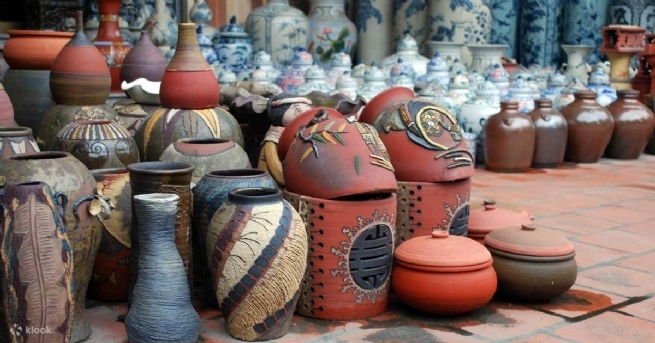
Water puppetry is a unique folk art form closely associated with the long-standing traditional culture of the Vietnamese people
According to Mr. Nguyen Van Chi, former Deputy Director of the Hanoi Department of Rural Development (now under the Department of Agriculture and Environment), it is necessary to develop a set of criteria for recognizing tourism craft villages that closely align with the standards of the World Crafts Council (WCC), comprising five groups of criteria: clear, continuous craft identity with high cultural value; handicraft products that are unique, creative, and environmentally friendly; craft communities with the capacity to organize, receive, and tell stories to visitors; village spaces that are well planned, with landscapes and infrastructure services meeting tourism standards; and the application of digital technology in promotion and international trade.
Once meeting WCC standards, Hanoi’s craft villages will not only assert their domestic brand but also open doors to the global market, attracting international visitors seeking to experience Vietnamese cultural values.
The City needs to review all 337 recognized craft villages and crafts that have faded but remain characteristic of the cultural identity of Trang An – Xu Doai, in order to classify them by capacity and characteristics. First is the group of heritage craft villages, focusing on preservation, restoration, and transmission. Second is the group of production–commercial craft villages, to be incorporated into concentrated industrial clusters, with pollution control and process modernization. Third is the group of tourism craft villages, prioritized for investment in tourism infrastructure and the development of the “one destination – multiple experiences” model.
If these three groups are planned in a synchronized manner, with policies supporting long-term cooperation between enterprises and artisans, Hanoi will form a value chain linking craft villages, tourism, culture, and creativity, contributing to the realization of the aspiration to become a “Global Creative Capital.”
“When crafts are preserved, villages have soul; when infrastructure is complete, tourism takes flight. Hanoi’s craft villages will not only be places where products are made, but also vibrant cultural symbols, contributing to elevating the Capital’s brand in the process of international integration,” Mr. Chi emphasized.
By Bao Dan, Vietnam Business Forum
|
This special section is supported by Hanoi Department of Agriculture and Environment |


 Vietnamese
