Resolution 91-NQ/TU, issued by the Tuyen Quang Provincial Party Committee on May 12, 2026, identifies transport infrastructure as a key driver for expanding development space. Alongside investing in regional transport links, the province is focusing on better planning and improving public investment efficiency to ensure the sustainable use of its resources.
Strengthening regional connectivity to expand development space
Resolution 91-NQ/TU targets continued infrastructure breakthroughs, prioritizing transport through 2030. Expressways form the network's backbone, connecting the province south to Hanoi and extending corridors to the northern highlands and border crossings.
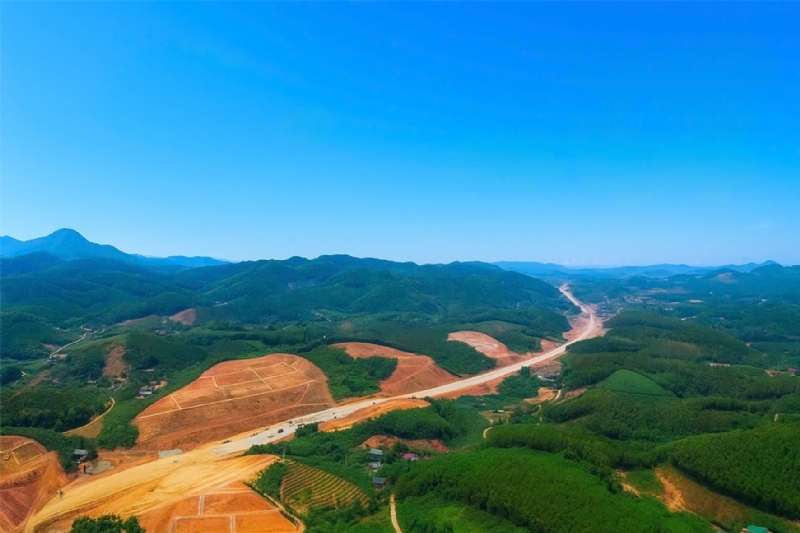
Construction of the Tuyen Quang–Ha Giang Expressway Project (Phase 1) is well underway
The 40-kilometer Tuyen Quang-Phu Tho Expressway, which opened in late 2023, has significantly improved connectivity and economic growth. Reduced travel times to Hanoi give the province better access to major markets, logistics hubs, skilled labor, and investment capital across northern Vietnam.
The Tuyen Quang-Ha Giang Expressway is opening a new northern development corridor. Phase 1, spanning 104.5 kilometers, began construction in 2023. On December 19, 2025, a section reached technical completion, paving the way for operations in 2026. Once open, the expressway will reduce freight travel times, boost tourism, and open up space for industry and logistics. Phase 2, extending to the Thanh Thuy International Border Gate, will complete the corridor from Hanoi to the border, creating an integrated route that links the midlands, central areas, and highlands with border trade while expanding commercial opportunities.
"Modern transportation is the key to unlocking new development opportunities. Every hour saved in travel reduces logistics costs, while every infrastructure bottleneck removed creates more room to attract investment. Tuyen Quang is steadily transforming from a terminal destination into an important link in a broader trade corridor," said Le Thanh Son, Director of the Tuyen Quang Department of Construction.
Transport breakthroughs extend beyond expressways. If expressways are the backbone of the transport network, rural roads, production roads, and rural bridges are the capillaries carrying development benefits to every community. For a mountainous province like Tuyen Quang, infrastructure delivers its full value only when remote farmers can bring produce to major roads, children travel to school more easily, and essential services become more accessible.
Guided by this approach, Tuyen Quang has achieved its goal of providing 100% of villages with paved road access to their centers. Under the 2024 plan, girders were installed for all 45 bridges. In 2025, construction began simultaneously on 39 bridges in Na Hang, Lam Binh, Chiem Hoa, Ham Yen, Yen Son, and Son Duong.
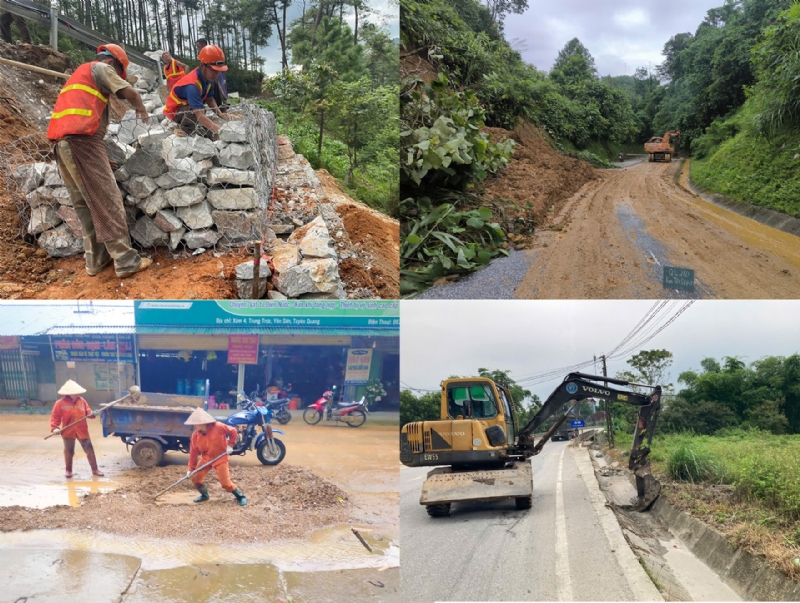
Timely maintenance on Tuyen Quang's major transport routes helps ensure safe and uninterrupted traffic
In mountainous areas, even a small bridge creates value far beyond its construction cost. Goods become less dependent on temporary roads and weather conditions, raw material areas connect more efficiently to national highways and expressways, and shorter routes from production sites to markets help increase product value.
The road linking the My Lam Hot Mineral Spring Tourism Area with National Highway 2D and the Tuyen Quang-Phu Tho Expressway is one example. The two main construction packages have reached 95-96% completion, creating a direct connection between the expressway and the resort area while expanding opportunities to attract investment in hospitality services.
If expressways expand development space and strengthen regional connectivity, rural transport brings those opportunities to every community. Only when the backbone is fully connected to the capillaries can infrastructure investment generate broad benefits and drive development across the province.
Planning as the foundation for sustainable growth
New roads create value, but they also increase development pressure along transport corridors. If planning lags behind infrastructure investment, the benefits of improved transport can quickly be eroded by fragmented development.
By early June 2026, the Department of Construction had completed the appraisal and approval of planning tasks for 89 of the province's 90 communes, reaching 98.9%. These included 31 urban master plans and 58 commune master plans. Following administrative mergers, the planning framework clearly defines areas for urban growth, industry, tourism, and conservation.
Alongside planning, the Department of Construction is strengthening discipline in public investment disbursement. Cumulative disbursement through June 30, 2026, is estimated at VND174 billion (US$7 million), equivalent to 31.5% of the plan managed by the department. Among the leading projects is Phase 1 of Tuyen Quang Provincial General Hospital, which has reached 88% of its planned disbursement.
| To help ensure safe and reliable road transportation, particularly during the rainy season, the Tuyen Quang Provincial Road Maintenance Management Board carries out continuous routine maintenance across its entire network. In 2025, the board carried out 79 projects and tasks: maintaining 27 roads, conducting periodic repairs on 19 projects, completing emergency repairs on 30 projects, and investing in three new projects. |
An estimated urbanization rate of 28.56% at the end of 2025 indicates considerable development potential, while requiring careful oversight to avoid scattered investment. Green, smart urban development begins with sound planning and strict quality control for every project.
Ultimately, building a newly expanded province means organizing development space so residents enjoy better living conditions, businesses can invest with confidence, and capital flows to projects that create lasting value. Tuyen Quang has adopted a consistent approach: using transportation to overcome geographic barriers, extending opportunities to every area through local roads, and using planning to guide orderly growth.
Taken together, the province's expressways, bridges, and planning framework form a unified development strategy: transportation opens new opportunities, planning guides spatial development, and disciplined construction management determines long-term value.
Ha Thanh - Trinh Long, Vietnam Business Forum