


The Ho Chi Minh City Centre for the Fourth Industrial Revolution (HCMC C4IR) recently organized a consultation event with representatives from business groups and trade associations to gather specific feedback to propose breakthrough policies in science, technology, innovation and digital transformation.
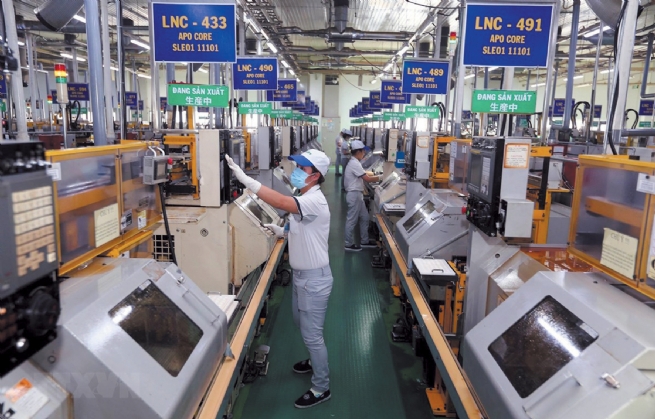
A Japanese-invested factory in Tan Thuan Export Processing Zone, Ho Chi Minh City
This marked an important preparatory step in finalizing a policy draft to be submitted to the HCM City People’s Council in May 2025, all with the overarching goal of enhancing the city’s competitiveness in innovation and technology.
Actively tackling obstacles
According to participating experts, beyond bottlenecks in administrative procedures, finance and tax policies, science and technology firms in Vietnam, including HCM City, often face challenges in dealing with regulatory agencies due to outdated management mindsets and obsolete legal frameworks that fail to keep pace with new technologies. Additionally, bureaucratic risk aversion often thwarts the testing and rollout of new tech products. Technically, existing regulations and standards are largely based on outdated technologies, making them incompatible with modern products, while overly detailed construction standards further suppress creativity. These impediments have significantly delayed scientific and technological progress and innovation in HCM City and across the country.
To address these challenges, Mr. Vu Van Dao, Director of the Southern Representative Office of the Vietnam Association of Mechanical Industry (VAMI), recommended updating legal frameworks and technical standards to better suit modern technologies and distinguishing between unintentional and intentional violations in criminal law to enable safer experimentation and development of new technologies. Besides, regulations should focus on safety frameworks, allowing flexibility in selecting materials and production methods to foster innovation and creativity among companies.
From another perspective, Truong Ly Hoang Phi, Vice President of the HCM City Young Business Association (YBA), said that private companies, especially those engaged in innovation and technology transfer, need more support in both mechanisms and resources. In fact, the current High-Tech Law does not adequately meet practical demands, and with only one qualified high-tech park in HCM City, the development of a broader tech ecosystem remains constrained. “The city needs to prioritize the development of private innovation centers, expand technology incubators both inside and outside of high-tech parks to provide an enabling environment for startup initiatives to be nurtured and developed. In addition, the city needs to leverage international cooperation agreements to mobilize capital and resources for innovation ecosystems. It should also establish stronger coordination between government, research institutes, universities, and businesses to commercialize research outcomes, and consider launching open innovation labs to foster deeper, more effective collaboration,” she proposed.
From a business perspective, Mr. Nguyen Huu Tuan, Deputy Director of Viettel Solutions, highlighted the fact that complex administrative procedures often hinder the implementation of science and technology projects, causing businesses to spend time and resources to tackle them. “Reforming in administrative procedures and reforming financial and tax policies are both urgent and vital to supporting businesses to launch technological initiatives and leverage scientific and technological development and innovation. One key solution is to expand the sandbox policy framework, allowing controlled testing of new technologies and regulations. In the long term, the sandbox policy should be expanded beyond technological spheres like blockchain but also for human resources and innovation professionals. This policy will enable businesses to experiment with innovations and provide authorities essential foundations to draft workable legal frameworks,” he suggested.
Igniting the rise of Vietnam’s tech innovators
Concluding the event, Le Truong Duy, Director of HCMC C4IR, said that the consultation marked a vital starting point in identifying core areas for future policies in science, technology, innovation, and digital transformation in HCM City. Based on the discussions, HCMC C4IR pointed out the necessity for prioritized support for business groups, including pioneers, tech firms, startups and SMEs in the manufacturing sector. As part of implementing Project 1413, HCMC C4IR will review areas without effective policy enforcement and propose suitable pilot mechanisms for gradual adoption and expansion. Tools developed by HCMC C4IR in collaboration with the World Economic Forum (WEF) are also being rolled out to help businesses self-assess their capabilities and readiness to join global value chains and formulate tailored innovation strategies to enhance their competitiveness.
Regarding priority actions, HCMC C4IR will carry out innovations in smart manufacturing and transformative technologies such as AI, semiconductors, 5G applications in industry, digital healthcare, the creation of an international technology exchange, and the development of centralized research hubs and AI-powered chatbot tools to support the municipal administration. These initiatives will be piloted using sandbox mechanisms as outlined in the National Assembly’s Resolution 98.
With respect to policy and operation mechanism, according to Duy, the center and the compiling board will propose three core policy groups: Public-private and public-public partnerships where clear rules on intellectual property ownership (e.g., patents) derived from research outcomes and responsibilities and benefits for all parties are defined; high-tech investment incentives including specific land, tax and credit policies to attract domestic and foreign high-tech firms; and expert development and attraction, including improved remuneration, intensive training programs, and science-tech awards to foster a knowledge-honored culture.
HCMC C4IR is also shaping a proposal regarding the establishment of a science and technology investment fund with a budget of VND200-300 billion, operating under a matching fund model (60% private and 40% public). The fund will be used to train 20-30 talents in core technology fields over the next 10-15 years, with the aim of achieving technological self-reliance. “On this occasion, HCMC C4IR also invites businesses, associations, research institutes and organizations, both domestic and foreign, to join the innovation network coordinated by HCMC C4IR. This network will play a crucial role in connecting resources, sharing data, aligning policies and facilitating the rollout of tech-innovation initiatives in HCM City toward pursuing a globally integrated, knowledge-based economy,” said Director Le Truong Duy.n
By My Chau, Vietnam Business Forum





 Vietnamese
