


The Son Dong woodcarving and lacquer craft village (Hoai Duc, Hanoi) has recently been proposed by the Hanoi Department of Agriculture and Environment to participate in the World Crafts Cities Network, according to Official Dispatch No. 6262/SNNMT-PTNT issued on 29 August 2025. At present, the locality is completing its application dossier for submission to the World Crafts Council for consideration and recognition.
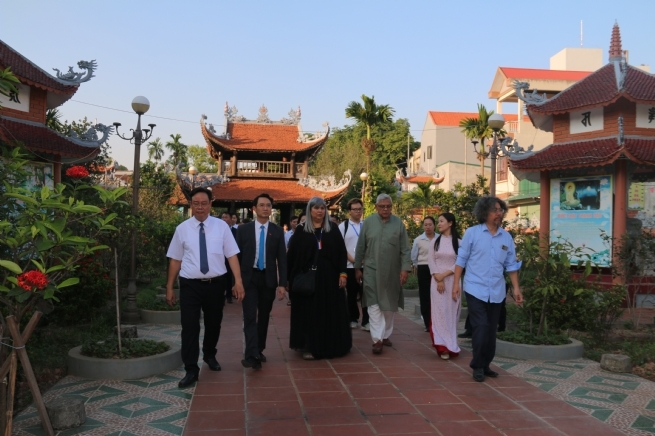
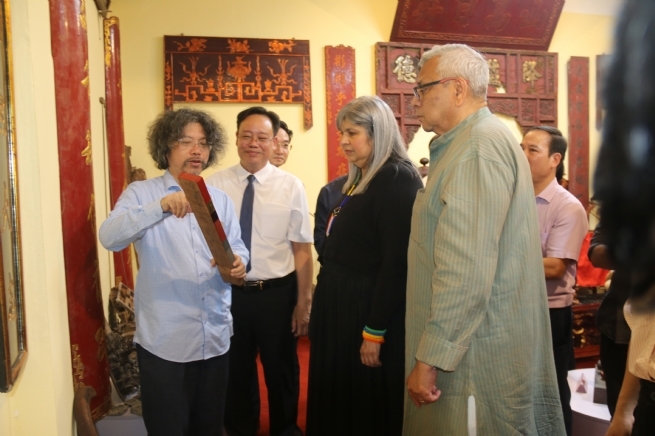
The international delegation of the World Crafts Council working and visiting Son Dong Craft Village
Participation in UNESCO’s Creative Cities Network is considered an important step forward, helping the craft village position its brand and promote its image across creative fields. The process of meeting the criteria for joining the Creative Cities Network not only affirms the development of the local creative economy, but also reflects international recognition of the role of traditional handicraft culture in socio-economic development. This also serves as a driving force for preserving and promoting distinctive cultural values, creating new high-value products, and aligning with sustainable urban development trends.
Mr. Nguyen Trung Hung, Officer of the Economic Division of Son Dong Commune, said that from May to August 2025, the Commune People’s Committee worked many times with the Department of Agriculture and Environment to assess the current situation and agree on criteria. To date, the commune has built a website introducing the history and products of the craft village; arranged a 40 m² skills transmission room to train 20–30 young learners; opened a 50 m² practice room; and compiled training materials for woodcarving and lacquer crafts.
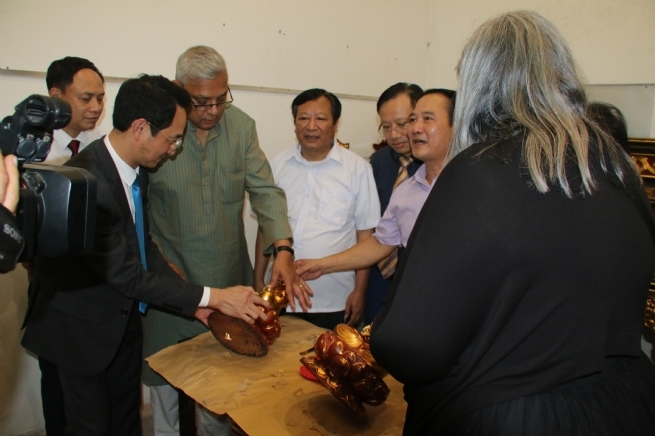
Mr. Sundeep Kumar, Vice President of the World Crafts Council for the Asia–Pacific region, impressed by the products of Son Dong Craft Village
The locality has also completed a 40 m² traditional exhibition space preserving royal decrees, artifacts, and documentation on the village’s development. A 50 m² creative design center has been refurbished, displaying sample patterns, materials, and lacquer surfaces; equipped with 3D design computers; and is expected to develop 30–50 new souvenir product models.
On 15 November, Son Dong Craft Village welcomed an international delegation as part of the appraisal program to recognize Chuyen My mother-of-pearl inlay and lacquer craft village as a member of the World Creative Crafts Cities Network in 2025. On this occasion, the reporter spoke with Mr. Sundeep Kumar, Vice President of the World Crafts Council for the Asia–Pacific region, about his impressions of Son Dong from the perspective of the World Crafts Council.
Today you visited Son Dong Craft Village. What are your impressions of the trip and your assessment of the village’s products?
I am very happy to visit Son Dong. What impressed me most is that there are still many people here who are deeply committed to preserving a long-standing and sophisticated traditional craft. The products are very beautiful, and I understand that to create them, artisans must invest a great deal of effort, skill, and time. We have also used some of these products, so we clearly understand the value of the labor behind each piece.
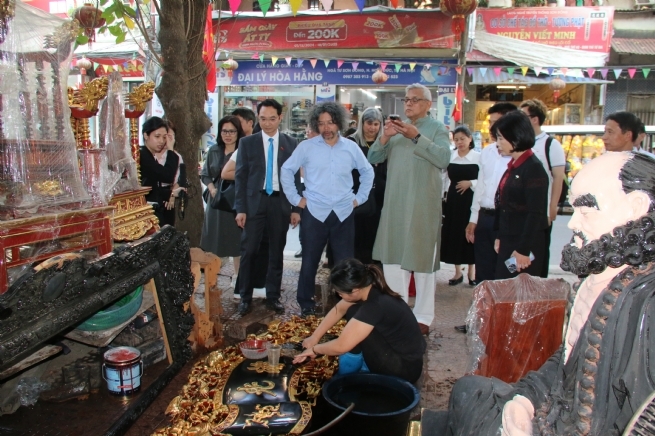
I am also pleased to see that the craft village has taken initial steps in innovation, especially in design thinking. I believe there is still great room for development. Today, if the aim is to reach the global market, not just the traditional domestic market, products need to be more compatible with living spaces, interior arrangements, and aesthetic tastes of international customers—people who typically make little use of ritual objects or traditional-style furniture.
Son Dong artisans possess tremendous craftsmanship skills accumulated over time. The important thing is to “overlay” these skills with a layer of modern design, based on the actual needs of different customer groups. Currently, products mainly serve traditional functions such as altar setups and ritual furniture, but not everyone has these needs. Consumers in other markets have entirely different demands.
Therefore, the questions that need to be asked are: What types of functional products does the global market need? How can products be designed to meet those needs while also aligning with the aesthetics of today’s younger generation?
Even in Vietnam, the number of young people purchasing traditional-style products may not be large if the products are not innovated. A handicraft can only develop sustainably if it continuously evolves in form, function, and design. I am very glad to see that Son Dong has begun moving in this direction, but you need to be even bolder. Do not worry too much about whether the products will sell or not; let your imagination soar—market-appropriate products will naturally emerge.
Do you have any advice for villagers during the process of renewing skills, applying design, or developing craft village tourism?
Today’s visit is a pre-appraisal mission by the World Crafts Council. We were invited to assess whether Son Dong meets the conditions to submit an application for recognition as a craft village.
After this pre-appraisal, if we find that the locality has potential, we will propose inviting an official jury delegation of 3–4 experts to conduct an evaluation. They will prepare a detailed report addressing all issues such as: improving tourism experiences; product design orientation; training and skills transmission activities; solutions to enhance economic efficiency and increase added value.
All of this will be presented in the official report, so I do not wish to give recommendations too early at this stage. Please wait for the conclusions from the official appraisal process.
Thank you very much!
|
Son Dong Craft Village – the enduring lifeblood of gilded wooden statue carving The Son Dong village of wooden statue carving and red-lacquer gilded sculpture has long attracted connoisseurs of ritual objects and decorative items thanks to its unique cultural and historical values. This is a craft village with enduring vitality throughout the nation’s history. Despite many periods of ups and downs, the lifeblood of the traditional craft has been preserved, expressed through each motif and pattern reflecting layers of cultural sediment. Son Dong still preserves many ancient relics such as communal houses, pagodas, temples, and ancestral halls. The village’s products account for more than 70% of the national market share for gilded and silvered statues and ritual objects, serving cultural and spiritual life. The village’s products are not only widespread across all three regions of the country but are also exported to many countries such as Russia, Ukraine, France, the United States, and Southeast Asian nations including Thailand, Laos, and Cambodia. |
Source: Vietnam Business Forum
|
This special section is supported by Hanoi Department of Agriculture and Environment |


 Vietnamese
