


An international financial center (IFC) in Ho Chi Minh City will bring together a wide range of professional financial intermediaries, both domestic and international, enabling them to collaborate effectively to support and strengthen the national economy.
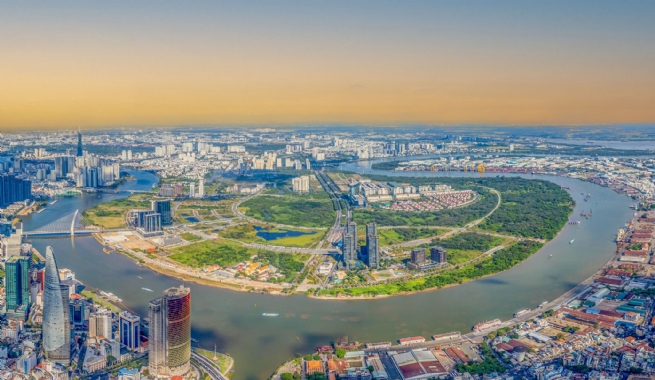
The Thu Thiem New Urban Area on the banks of the Saigon River, Ho Chi Minh City
Financial services - a catalyst for sustainable growth
In today’s globalized world, where knowledge and networks are key, urban centers are increasingly important as hubs of economic, social, and cultural activity, and as sites for economic governance and policy experimentation.
A well-functioning market economy with sound economic governance depends on understanding how cash flows from available resources to manage financial health and guide strategic planning. Businesses and organizations must track the sources of cash (inflows) and its uses (outflows) to meet obligations and achieve financial goals. Key components of economic governance include cash flows from operations (core business activities), investments (long-term assets), and financing (debt and equity). Careful analysis of these cash flows enables accurate forecasting, effective liquidity management, and optimal productivity. Bottlenecks arise when resources are not efficiently converted into cash flows or transparently valued within national socio-economic development plans.
In Vietnam, although the economy ranks 33rd in the world by GDP, economists have identified unsustainable practices in financial resource management across three main sectors:
First, the government is actively implementing Resolution 68-NQ/TW on private sector development with a target of 2 million enterprises by 2030. The Budget Law has also been revised to support fiscal policy, accelerate disbursement, and promote public-private partnerships (PPP).
Second, enterprises are key drivers of innovation and digital transformation. However, the number and scale of businesses remain small compared with actual needs. Many still operate with short-term strategies rather than sustainable plans. Furthermore, numerous companies do not base operations on sound financial investment tools, such as Internal Rate of Return or Net Present Value, instead prioritizing short-term market trends, inflated pricing, reduced quality standards, or delayed project schedules, leading to debt accumulation, liquidity challenges, cross-ownership issues, unfair competition, corruption, waste, and opportunity costs for society.
Third, households, despite limited income due to wage policies, contribute significantly through remittances, which have ranged from US$16 billion to US$18 billion annually in recent years, positioning them as important investors in the economy. However, statistics indicate that a large portion of these funds is invested in residential real estate rather than productive sectors. Most investment targets high-end commercial housing, fueling speculation, price surges, real estate bubbles, and inflation risks.
Most economic governance experts agree that all financial resources must be managed effectively and systematically to ensure sustainable economic growth. In Vietnam, a breakthrough in development must prioritize financial resource management, as the financial and banking sector is the lifeblood of the economy and international trade, even if it is not a growth sector itself. Banks shape and support economic activity, infrastructure development, and financial technology. Consequently, financial services should be recognized as a growth tool for priority industries and as a means of increasing individual net worth in a country of nearly 100 million people.
Long-term strategy needed
To strengthen sustainable management of the nation’s financial resources and enhance global integration, the National Assembly issued Resolution 222/2025/QH15 on establishing an IFC in Vietnam. The development of an IFC in Ho Chi Minh City is a long-term strategic initiative. Saigon Marina IFC is designated as the inaugural project, providing modern infrastructure and high-quality office space to support financial, investment, and international business activities in the city. An IFC located in Vietnam’s economic hub will concentrate a wide range of professional financial intermediaries, both domestic and international, working together to serve national economic stakeholders efficiently.
However, establishing an IFC requires a multi-faceted approach, considering both theoretical and practical aspects. Financial experts emphasized that for Ho Chi Minh City to become an IFC, five key priorities should be pursued:
First, develop financial infrastructure to build a strong, modern foundation supporting sustainable IFC growth and establishing credibility from the outset. This includes fostering relationships between domestic financial institutions and foreign organizations, as well as connecting the IFC to other markets. Expanding capital markets to provide opportunities for foreign investors is also essential.
Second, develop a comprehensive, highly liquid money market to offer ample investment opportunities for domestic and international investors, a critical factor in IFC development. Transparency in monetary policy, including exchange rates and interest rates, and enhanced market management, foreign exchange reserves, and precious metals oversight are also important.
Third, the government should guide sustainable IFC development through clear national policy messages emphasizing accountability in public investment and taxation. Prompt implementation of Decision 1250/QD-TTg dated October 26, 2023, with concrete guidance for executing the 2023 Pricing Law (Law 16/2023/QH15), will improve pricing quality and effectiveness.
Fourth, strengthen macroeconomic stability and sustainable resource governance. Effective management of financial resources and markets ensures the continued flow of capital, the lifeblood of the national economy, in a volatile global market. Macroeconomic stability reduces inflation, balances trade and budgets, and supports the IFC’s prominent position among leading international financial centers.
Fifth, enhance international cooperation. Developing comprehensive strategic partnerships and participating in global financial mechanisms will increase foreign capital inflows, mitigate exchange rate risks, and strengthen Vietnam’s global market position. International collaboration should also support fintech, AI, Big Data, and machine learning adoption to improve analytical and forecasting capabilities. Piloting digital asset markets and establishing a comprehensive risk management system to ensure cybersecurity are important steps. Additionally, a strategy combining professional training with a stable and attractive work environment is necessary to retain skilled IFC personnel.
Developing Ho Chi Minh City IFC requires integrating sustainable governance of the nation’s five resource sectors with active international cooperation. With its historical role as the country’s economic leader, coupled with decisive government guidance and implementation of these priorities, the Ho Chi Minh City IFC will contribute to building a modern megacity and establishing the city as a leading urban center in the Asia-Pacific region.
Dr. Doan Duy Khuong - Dr. Nguyen Duc Tho
Source: Vietnam Business Forum





 Vietnamese
